
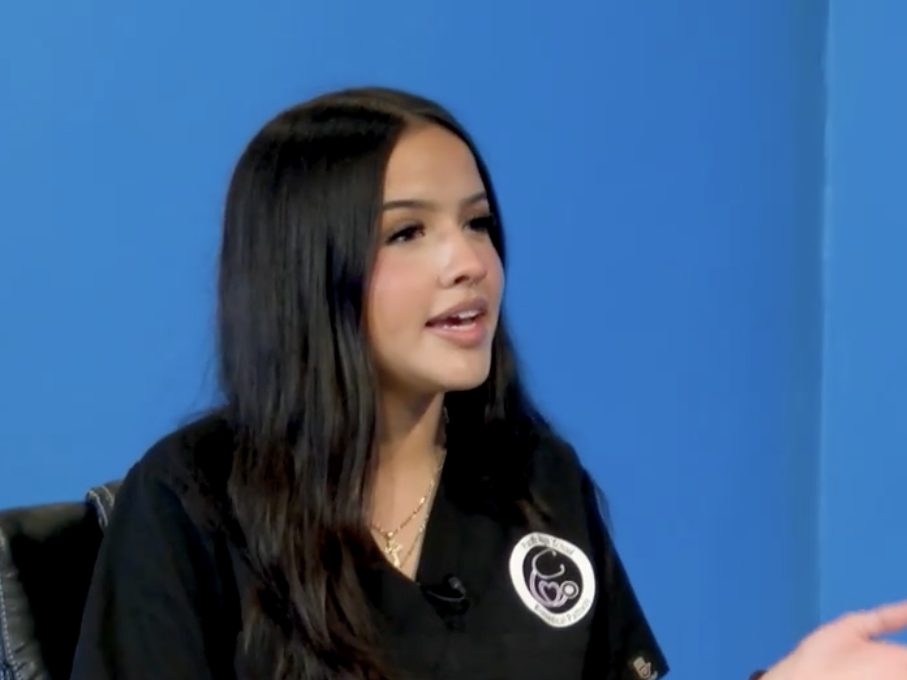
In this must-watch video, Yesenia Soto, a recent graduate of Pacific High School in San Bernardino City Unified (a Secondary Redesign Pilot district in the Linked Learning Alliance network), offers a glimpse of what’s possible when high school is designed differently.
Watch the video on YouTube (opens in a new tab)
Over the past four years in the school's Project Lead the Way Biomedical Honors Pathway, Yesenia has trained on EKG machines and oximeters, dissected fetal pigs and cow eyes, and spent time in mock exam rooms designed to mirror clinical settings. Her senior capstone explored music therapy, applying three years of learning to a real-world question in medicine. Through a community clinic partnership on campus, students in the pathway also gain hands-on experience while supporting students who face financial barriers to health care. It’s not what most people picture when they think about high school.
Pacific’s biomedical pathway isn’t simply a program layered on top of school as usual. Learning is designed to be specific and engaging, connected to the community and real-world contexts, and applicable across disciplines. That’s the idea at the heart of the Linked Learning approach: rigorous college-prep academics, a sequenced career-technical program, work-based learning, and integrated student supports aren’t separate parts of a student’s day—they’re designed to reinforce one another. Pacific’s biomedical pathway, which holds Linked Learning Gold Certification, is supported by a 12,570-square-foot purpose-built facility and a pedagogical model centered on activity-, project-, and problem-based learning. Experiences like Yesenia’s don’t happen by chance; they’re the product of intentional school design.
What’s most striking in Yesenia’s telling, though, is what she carries with her beyond the pathway itself. Not the equipment. Not the procedures. It's the ability to disagree productively with peers about a diagnosis. It's learning to find her voice in rooms where hierarchy usually silences it. It's the empathy required to introduce yourself to a patient before touching them. They’re also the skills she sees herself carrying beyond healthcare: Yesenia plans to study business economics and hopes to work in the business side of healthcare. She describes the collaboration, communication, and other skills she developed through the pathway as transferable to any profession.
Those are the kind of outcomes that make Yesenia’s story about more than one exceptional biomedical pathway. As the world changes, school redesign asks what students need to thrive, and what schools need to look like to develop those capacities intentionally. Pacific High School offers a vivid example of what becomes possible when school is designed around the outcomes and experiences its community has decided students need to thrive.
When you have a moment, listen to Yesenia tell it herself (opens in a new tab).