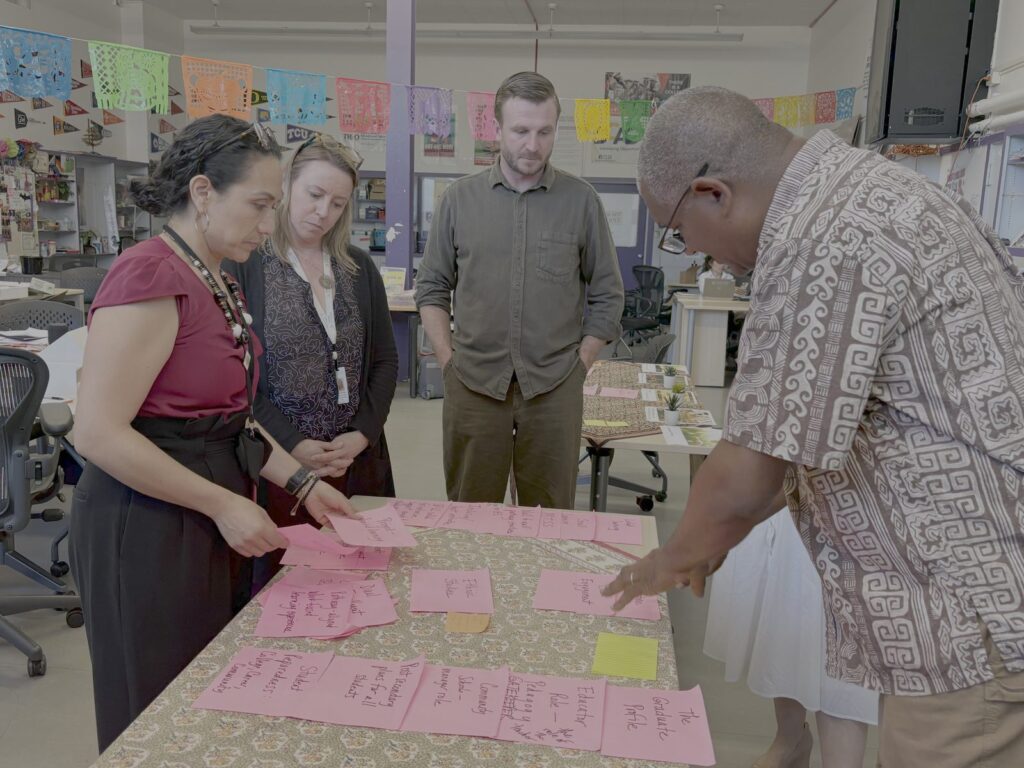

A new case study on Hillsdale High School in San Mateo, authored by Barnett Berry and Greg Jouriles and produced by RedesignEd (one of our pilot networks), offers a close look at what becomes possible when teacher leadership is built into a school’s daily structure rather than reserved for a few formal roles.
Hillsdale High School in San Mateo demonstrates what can happen when teacher leadership is built into a school’s daily structures and culture rather than limited to a small number of formal roles. Beginning with disengagement and lagging achievement, Hillsdale redesigned the school so that students are known well and adults take collective responsibility for their learning and development. The mechanism is not a single program but a coherent architecture: small learning communities organized into houses; interdisciplinary teams sharing the same 110-120 students and looping with them for two years; advisory; heterogeneous classes; interdisciplinary and project-based learning; and, critically, a master schedule protecting time for teachers to work together. Weekly Kid Talk turns that architecture into practice as teachers, counselors, specialists, and administrators pool what they know about individual students and coordinate responses across classrooms. Teacher leadership consequently becomes less a position than a system property: teachers exercise collective professional judgment within shared students, shared time, shared evidence, and shared responsibility.
More than two decades in, this architecture is producing results that matter. Hillsdale continues to see gains in student achievement and graduation rates as its student body grows more diverse, and recent survey data show 82% of students report high levels of belonging, considerably higher than peer comprehensive high schools in the district.
What makes Hillsdale especially consequential is that teacher leadership is not a role assigned to a few people; it is built into the work of every teacher. Daily common planning, house teams, Kid Talk, shared governance, curriculum and assessment design, and rotating facilitation require teachers to lead one another while remaining accountable to shared students and team commitments. Because of some tough choices, including a more focused, interdisciplinary curriculum and fewer electives, teachers have from four to eight hours to learn from each other.
Just as important, the teachers association became an institutional partner in making this leadership scalable and durable. Association leaders were themselves accomplished classroom teachers; the association helped build faculty support, negotiate waivers around loads, time, assignments, and staffing, and ultimately embed collaboration, advisory, professional responsibility time, peer review, and curriculum-design work into the collective bargaining agreement. The redesign therefore did not depend on a charismatic principal or a handful of teacher leaders: the association helped convert innovations developed at Hillsdale into protected working conditions and professional norms that could survive leadership turnover and potentially travel across schools.
That is a critical lesson for another network: build teacher leadership into the daily architecture of teaching, and engage the association not as a gatekeeper to redesign but as a co-designer of the conditions that allow it to spread and endure. As Danielle Flores puts it, “leadership here is not about being in front, but about all of us being side by side.” The full report is available here (opens in a new tab).